

Exploring sunken ships and planes is thrilling. It needs the right scuba certification. Wreck diving is special because it needs its own skills and knowledge.
To be a certified wreck diver, you must get special training. This training teaches you about safety, how to navigate, and how to explore wrecks underwater. It’s key for a safe and fun dive.
Key Takeaways
- Proper scuba certification is required for wreck diving.
- Wreck diving involves exploring submerged structures and requires unique skills.
- Specialized training is necessary for safe wreck diving practices.
- Certifications ensure divers are equipped with the necessary knowledge.
- Safety procedures are a critical component of wreck diving training.
The Fascinating World of Wreck Diving
Wreck diving is more than just seeing old ships underwater. It’s a journey through history. Divers find the stories of old ships fascinating. These stories tell of the sea’s past, cultures, and sometimes, sad events.
What Makes Wreck Diving Unique
Wreck diving is special because it mixes adventure, history, and mystery. Exploring an old ship underwater is exciting. You see marine life and learn about the past.
Historical and Ecological Significance
Wrecks are not just old ships. They are also homes for many sea creatures. They help keep the ocean healthy.
Types of Wreck Diving Experiences
There are many ways to dive wrecks. Each one is for different levels of skill and interest.
Recreational Non-Penetration Diving
This type of diving lets you see the wreck from outside. It’s good for beginners with some scuba skills.
Limited Penetration Diving
In this diving, you go inside the wreck but stay near the door. You need some experience and special training.
Full Penetration Technical Diving
This diving goes deep into the wreck. It needs advanced skills and special gear.
| Type of Diving | Skill Level | Training Required |
|---|---|---|
| Recreational Non-Penetration | Basic | Scuba Diving Certification |
| Limited Penetration | Intermediate | Wreck Diving Specialty Course |
| Full Penetration Technical | Advanced | Technical Diving Certification |
Prerequisites for Wreck Diving Training
Wreck diving is a special skill that needs a good base in scuba diving. To start wreck diving training, you must have certain skills and experience.
Minimum Certification Requirements
To start, you need a basic scuba certification. This could be Open Water Diver from PADI or SSI. It shows you know the basics of scuba diving and how to stay safe.
Recommended Experience Levels
Having a basic certification is just the start. Wreck diving also looks for a certain level of experience.
Logged Dives
You should have many logged dives, 25-50 or more. This shows you’re comfortable and good underwater.
Comfort in Open Water
Being comfortable in open water is key. You need to know how to handle yourself in different conditions.
Essential Skills to Master First
Before diving into wreck diving, you need to learn some important skills.
Buoyancy Control
Buoyancy control is very important. It helps you save energy and not damage the wreck or disturb the sediment.
Navigation Fundamentals
Knowing navigation fundamentals is also crucial. It helps you find your way around the wreck and back to the exit.
Open Water Certification: The Foundation
Open water certification is the first step in scuba diving. It teaches basic skills and safety. These are needed for more advanced training.

Skills Covered in Basic Scuba Training
Basic scuba training teaches important skills. You learn how to use equipment, navigate underwater, and handle emergencies. These skills are key for safe diving.
How Open Water Prepares You for Wreck Diving
Open water certification gets you ready for wreck diving. It teaches you how to control your buoyancy and navigate underwater. These skills are important for wreck diving.
Limitations of Basic Certification
Open water certification is important but has limits. It doesn’t prepare you for wreck diving’s complexities. You need more training and experience to dive safely on wrecks.
Advanced Open Water and Specialty Courses
Advanced courses are key for safe and fun wreck diving. They teach divers to handle complex underwater places.
Deep Diving Specialty
The Deep Diving Specialty is vital for wreck diving. Many wrecks are too deep for basic scuba training. It teaches how to deal with deep diving risks.
Depth Requirements for Common Wrecks
Many historical wrecks are deep, needing deep dive certification. Some wrecks are as deep as 130 feet, needing advanced training.
Managing Nitrogen Narcosis
Nitrogen narcosis is a danger of deep diving. Training shows how to spot and handle it for safe diving.
Underwater Navigation Specialty
Underwater navigation is key for wreck diving. It teaches how to find and move around wrecks safely. Divers learn to use compasses and natural ways to navigate.
Night Diving Experience
Night diving is a useful specialty. It teaches how to dive in the dark. This skill is great for wreck diving, especially in dark places.
Enriched Air (Nitrox) Certification
Nitrox certification lets divers use enriched air. This can make dives longer and safer. It’s good for wreck diving, where divers want to explore more.
Wreck Diving Training Programs by Agency
Many training programs help divers learn about wreck diving. These programs teach the skills needed to dive safely around wrecks.
PADI Wreck Diver Specialty
The PADI Wreck Diver Specialty course teaches the basics of wreck diving. It covers both theory and practical skills.
Course Structure and Duration
The course has dives and classroom sessions over a few days. The time needed can change based on the center and students.
Certification Requirements
To get certified, you need to do a set number of dives. You also have to pass exams and show you can dive wrecks well.
SSI Wreck Diving Specialty
The SSI Wreck Diving Specialty course is similar but different. It focuses on both theory and practical skills for wreck diving.
Training Differences from PADI
Both PADI and SSI offer great training. But SSI might focus on safety or techniques in a unique way.
NAUI Wreck Diving Course
NAUI’s Wreck Diving Course teaches a lot about wreck diving. It covers safety, using equipment, and caring for the environment.
SDI Wreck Diver Course
The SDI Wreck Diver Course teaches the skills for safe wreck diving. It covers basic and advanced wreck diving techniques.
TDI Advanced Wreck Diving
TDI’s Advanced Wreck Diving course is for more experienced divers. It teaches advanced safety and techniques for complex dives.
Many agencies offer wreck diving training for all levels. When picking a program, think about the course, what you need to do, and how each agency teaches.
Core Skills Taught in Wreck Diving Courses
Wreck diving courses teach divers how to safely explore underwater wrecks. These skills help avoid risks and make diving more fun.
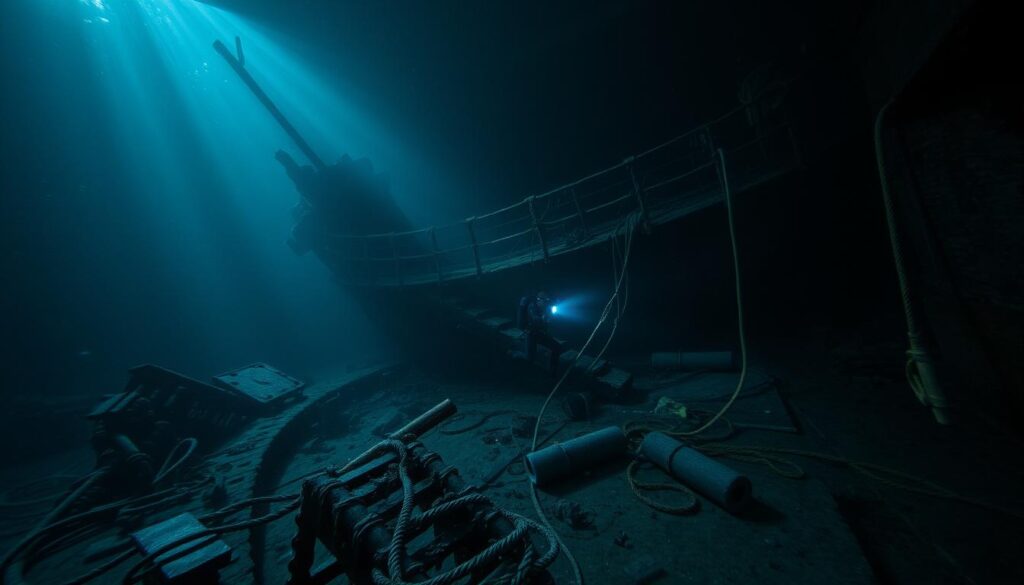
External Survey Techniques
External survey techniques are key in wreck diving. They help assess the wreck’s condition and plan the dive. Divers learn to survey the wreck’s exterior before diving.
Limited Penetration Skills
Limited penetration skills are for diving inside wrecks. Divers learn to navigate inside using guidelines and work as a team.
Guideline Use
Guidelines are crucial in wreck diving. Divers learn to lay and follow guidelines to avoid getting lost inside the wreck.
Team Protocols
Team protocols are important for safe wreck diving. Divers learn to communicate, stay together, and handle emergencies as a team.
Line Laying and Management
Line laying and management are key skills. They help divers safely enter and exit the wreck and navigate around it.
Emergency Procedures
Emergency procedures are a big part of wreck diving training. Divers learn how to handle emergencies like lost lines and running out of air.
Lost Line Protocols
Lost line protocols help divers deal with lost guidelines. They teach divers to stay calm, try to find the line, and signal for help if needed.
Out-of-Air Scenarios
Out-of-air scenarios are critical emergencies. Training includes learning to share air with a buddy and make a safe ascent.
Mastering these skills makes wreck diving safer and more enjoyable. The training from wreck diving courses is very helpful for exploring underwater wrecks.
Essential Equipment for Wreck Diving
Wreck diving needs special gear for safety and success. It’s important to have the right equipment, especially for going inside wrecks.
Basic Wreck Diving Gear
The basics include a good scuba set. This includes a regulator, BCD, and dive computer. You also need a wetsuit or dry suit for the water.
Specialty Equipment for Penetration
For going inside wrecks, you need specialized equipment. This includes:
- Primary and Backup Lights: Good lights are key for seeing inside wrecks.
- Reels and Line Markers: These help you find your way and mark exits.
Primary and Backup Lights
Use a bright primary light and a backup light. This way, you can keep going if your main light goes out.
Reels and Line Markers
Reels lay a line to guide you. Line markers show the way to the exit.
Redundancy Systems
Redundancy is very important in wreck diving. This includes:
- Backup Air Sources: Like a spare regulator or an isolation manifold.
- Cutting Tools: For emergencies when you get stuck in debris.
Backup Air Sources
A backup air source can save your life in an emergency.
Cutting Tools
A cutting tool, like a knife or shears, is vital for getting free if you get stuck.
Configuration Considerations
Think about how your gear is set up. Make sure it doesn’t get in the way or cause you to get stuck. Keep your gear streamlined and secure.
Safety Protocols in Wreck Environments
Wreck diving is exciting but also risky. It’s important to follow strict safety rules. These rules help avoid dangers like getting stuck or the wreck falling apart.
Common Hazards on Shipwrecks
Shipwrecks can be dangerous. They might be in bad shape or in a bad place. Divers need to watch out for these dangers.
Entanglement Risks
Getting stuck is a big risk. This can happen with loose wires or nets. Divers should know how to get free without getting stuck more.
Structural Instability
Wrecks might not be stable. Parts can fall or break. Divers should be careful of their surroundings.
Gas Management for Overhead Environments
Managing air is key in wreck diving. Divers need to plan their air use. This includes for emergencies.
| Dive Phase | Gas Requirement | Considerations |
|---|---|---|
| Entry and Exploration | Initial Gas Supply | Plan for enough air for exploring |
| Penetration | More Gas for Deeper Penetration | Think about how deep and complex the dive is |
| Exit | Gas for Safe Exit | Make sure you have enough air to exit safely |
Buddy System Protocols
The buddy system is very important. Divers should stick together. They need to know where each other is and if they’re okay.
“Dive with a buddy, stay with a buddy, and when you surface, tell your buddy you are surfaced.” – PADI
Emergency Planning
Even with planning, emergencies can happen. Divers should be ready for lost diver situations and equipment failures.
Lost Diver Procedures
If a diver gets lost, they should stay calm. They should stay in one place and signal for their buddy. The buddy should search carefully.
Equipment Failure Response
Knowing how to handle equipment failure is important. Divers should know how to fix problems and have backup gear.
Advanced Wreck Diving Training
Divers who want to dive wrecks need special training. This training helps them dive safely in wrecks. It teaches them how to handle wreck diving’s challenges.
Technical Wreck Diving Courses
Technical wreck diving courses are for experienced divers. They learn advanced techniques and safety steps. This is for diving deeper and more complex wrecks.
Extended Range Training
Extended range training lets divers dive deeper wrecks. They learn about the risks and safety steps for deep dives.
Decompression Procedures
Decompression procedures are key in wreck diving. Divers learn to manage decompression. This helps avoid diving sickness.
Full Penetration Training
Full penetration training is for diving into wrecks. It teaches how to safely move through wrecks’ interiors.
Mixed Gas Use for Deep Wrecks
Mixed gas use is vital for deep wrecks. Divers learn about gas mixtures and safe use.
Trimix Certification
Trimix certification teaches using oxygen, nitrogen, and helium for deep dives. It’s a special skill for deep dives.
Rebreather Options
Rebreather options are part of advanced wreck diving. Rebreathers recycle gas, making dives longer and more efficient.

Advanced wreck diving training is a big step for divers. It’s an investment for exploring wrecks safely. With the right training, diving wrecks can be a rewarding experience.
Wreck Navigation Techniques
To navigate wrecks safely, divers must learn many techniques. These include natural navigation and following lines. Knowing how to navigate wrecks is key for a great dive. It lets divers explore without getting lost.
Natural Navigation on Wrecks
Natural navigation uses the wreck’s features and the environment to stay on track. It’s very important for wreck diving. It helps divers know where they are.
Using Structural Features
Divers use the wreck’s layout to navigate. This includes corridors, rooms, and landmarks. Knowing these helps divers stay oriented.
Light and Current Indicators
Light and water currents also help with navigation. For example, knowing the current direction helps plan exits.
Compass Use in Enclosed Spaces
In complex wrecks, a compass is very important. It keeps divers on track and prevents getting lost.
Line Following and Markers
Following lines is key for navigating wrecks, especially in penetrations. Divers use lines to guide themselves and mark important spots.
Primary Line Management
Managing the primary line is very important. It involves laying out the line, making sure it’s secure, and knowing how to follow it back.
Jump and Gap Procedures
Jump and gap procedures are used for short distances without a line. Divers temporarily leave the line to cross gaps and then rejoin it.
Preparing for Wreck Diving Certification Exams
Certification exams for wreck diving need you to know a lot. You must understand both theory and practical skills. To get certified, you must pass two parts: knowledge review and practical skills.
Knowledge Review Components
The knowledge review checks if you know wreck diving basics. You’ll learn about safety, the environment, and how to dive wrecks. It’s all about studying wreck diving techniques and safety rules.
Practical Skills Assessment
Practical skills are tested in the water. You’ll show you can dive well, solve problems, and stay safe. This includes skills like navigating, controlling your buoyancy, and handling emergencies.
In-Water Demonstrations
In-water demos let you show off your diving skills. You’ll navigate wrecks and do emergency drills.
Problem-Solving Scenarios
Problem-solving tests how you handle unexpected issues. This could be fixing a broken piece of gear or finding your way through a wreck.
Study Resources and Materials
To get ready for exams, use study materials from places like PADI or SSI. They offer books, online courses, and practice tests. These help you learn and practice for the exams.
Legal and Ethical Considerations
Wreck diving has many rules and ethics. Divers must follow these to stay safe and respect the sites. These sites are important for history and culture.
Protected Wreck Sites in the United States
The U.S. has laws to protect old wrecks. The National Historic Preservation Act is one. Divers need to know these laws to avoid trouble.
Artifact Collection Regulations
Laws like the Abandoned Shipwreck Act control taking things from wrecks. It’s important to know this. Taking things can hurt the wreck and is often illegal.

War Grave Etiquette
Wrecks that are graves need respect. Divers should know how to act. This means not disturbing the remains or memorials.
Conservation Principles
Divers help keep wrecks safe. They should not touch or take parts of the wreck. This helps keep the site for others to see in the future.
| Regulation | Description | Impact on Divers |
|---|---|---|
| National Historic Preservation Act | Protects historical sites, including wrecks | Divers must avoid damaging protected sites |
| Abandoned Shipwreck Act | Regulates the removal of artifacts from wrecks | Divers are prohibited from removing artifacts |
By following these rules, wreck divers can dive safely. They also help keep historical sites safe for everyone.
Cost Analysis of Wreck Diving Training
Divers looking to get wreck diving certified need to think about several costs. These include course fees, the cost of equipment, and the cost of ongoing education.
Course Fees by Certification Level
Course fees change a lot based on the certification level. Basic wreck diving courses start at about $200. But, advanced courses can cost more than $1,000.
| Certification Level | Average Cost |
|---|---|
| Basic Wreck Diving | $200-$500 |
| Advanced Wreck Diving | $500-$1,000 |
| Technical Wreck Diving | $1,000-$2,500 |
Equipment Investment
Wreck diving needs special gear like rebreathers and penetration reels. This gear can cost a lot. Divers should plan to spend at least $1,000 on basic equipment.
Ongoing Education Costs
Wreck divers need to keep learning. This includes costs for workshops, online courses, and special training sessions.
Value Considerations
Even though the costs are high, wreck diving training is worth it. It offers unique experiences and helps save historical sites. As one diver said,
“The investment in wreck diving training is not just financial; it’s about preserving history and exploring the unknown.”
Applying Your Wreck Diving Training
Using wreck diving training means diving on wrecks. You learn from each dive. This helps you get better at what you learned in the wreck dive course.
Building Experience Progressively
Start with beginner-friendly wrecks. They are safe for learning wreck navigation and other skills.
Beginner-Friendly Wrecks
These wrecks are shallow and have clear water. They are perfect for new divers to get better.
Advanced Wreck Opportunities
When you get more experience, dive on harder wrecks. These are deeper or have complex structures. You’ll need better wreck navigation skills.
Joining Wreck Diving Communities
Join wreck diving groups. You’ll learn from others, find new wreck sites, and go on guided dives.
Documentation and Photography Skills
Learning to document and take photos makes diving better. You can show the beauty of wrecks to others.
Participating in Wreck Conservation Projects
Many groups work to save wreck sites. Helping out makes diving more meaningful and helps preserve history.
Conclusion
Wreck diving is a special and rewarding adventure. It needs the right training and scuba certification. This article gives tips for a safe and fun wreck diving journey.
Getting the right scuba certification is key. It lets divers see the amazing world of wreck diving. They can find out historical secrets and see the beauty of these sites.
As divers learn more, they get better at wreck diving. They become more confident and ready for harder dives. Wreck diving training is a big step for a diver’s skills and safety.
It opens up new chances to explore and find new things. With special training and certification, divers can fully enjoy wreck diving. They get to see the underwater world in a new way.
FAQ
What is the minimum certification required for wreck diving training?
You need an Open Water Diver certification. This is from a place like PADI or SSI.Diver certification – Wikipedia
What skills are covered in basic scuba training?
Basic scuba training teaches you how to stay afloat and breathe underwater. It also covers how to navigate.
What is the importance of advanced open water and specialty courses for wreck diving?
These courses teach you how to dive deeper and navigate underwater. They help you explore wrecks safely.
What are the different wreck diving training programs offered by various agencies?
Agencies like PADI and SSI offer wreck diving courses. Each has its own features and rules. You can pick the one that fits you best.
What core skills are taught in wreck diving courses?
Wreck diving courses focus on navigation and how to safely enter wrecks. They also teach you about emergency procedures.
What equipment is necessary for wreck diving?
You’ll need special gear for wreck diving. This includes basic equipment and tools for deeper dives.
How do you navigate a wreck?
To navigate a wreck, use natural signs and compasses. You also need to know how to follow lines and manage them.
What safety protocols are crucial in wreck environments?
Safety is key in wreck diving. This includes planning, managing your air, and knowing what to do in emergencies.
What are the legal and ethical considerations involved in wreck diving?
Wreck diving has rules to follow. You must respect protected sites and follow conservation principles.
What is the cost of wreck diving training?
The cost of wreck diving training varies. It depends on the course, equipment, and ongoing education. But it’s worth it for a great diving experience.
How can I apply my wreck diving training?
Use your training by diving more and joining wreck diving groups. You can also improve your photography and help with wreck conservation.
What is the wreck diving certification process?
To get certified, you need to finish a course and pass a test. A certified instructor will check your skills.


